HOW TO SCALE OFFENSIVE SECURITY WITH LORIKEET’S CONTINUOUS MONITORING PLATFORM
Architecture & Design Principles Lorikeet’s design philosophy centers on fidelity, traceability, and operational continuity. Key technical decisions infer...
From PDF to Platform: Real-Time Offensive Security for Modern Stacks
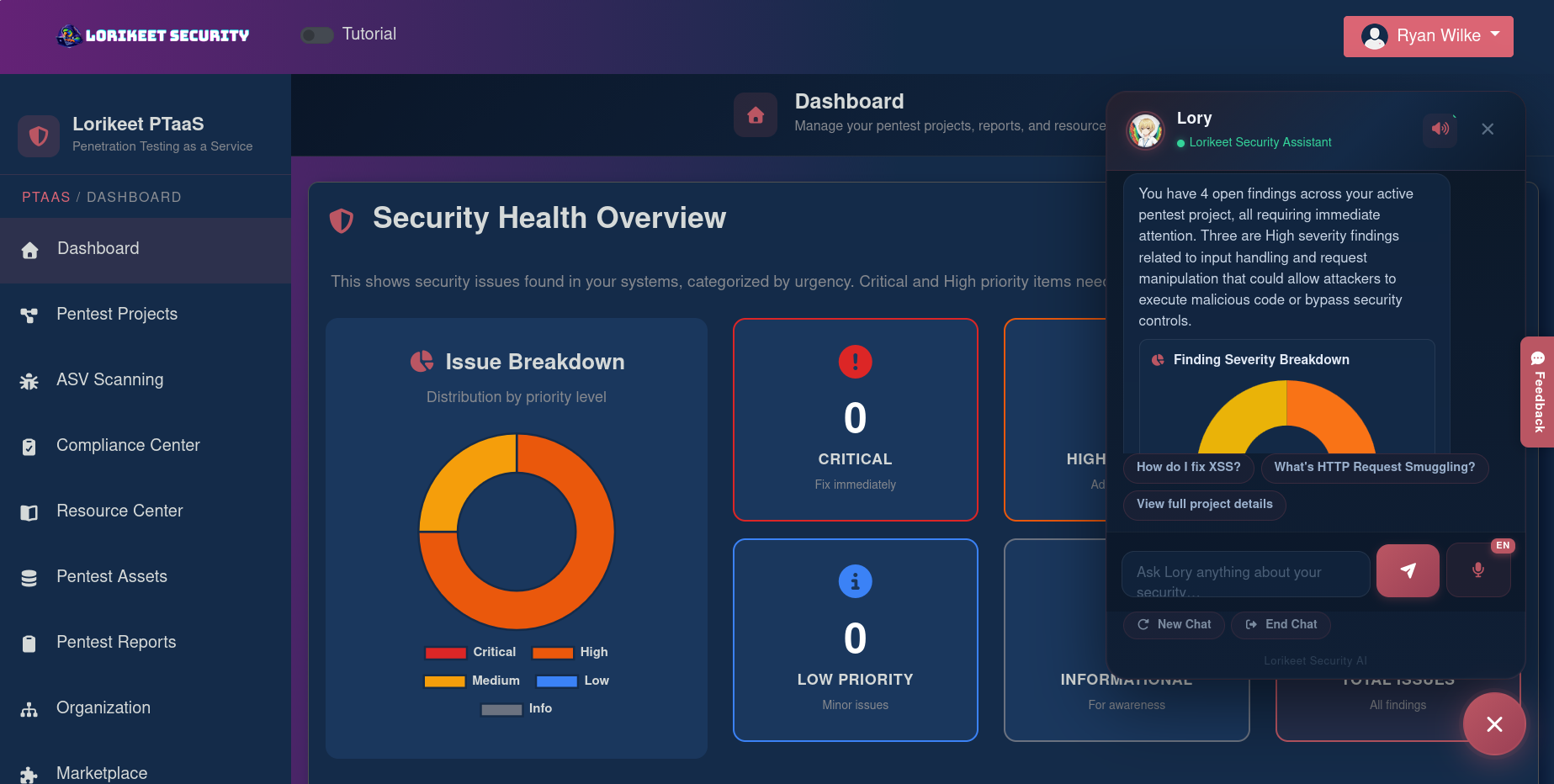
You know the drill — a PDF pentest report arrives, a week of frantic fixes, and three months later the same class of vulnerabilities reappears. Lorikeet Security tackles that friction by turning discrete engagements into a continuous security program. The platform layer is the differentiator: a real‑time portal with live engagement tracking, 24/7 attack surface monitoring, and Lory — an AI assistant trained on ~2,000 vulnerability entries. Architecturally it fuses human-led, 100% manual penetration testing with automated telemetry and compliance automation, aiming to convert one‑off findings into tracked remediation workflows and audit‑ready artifacts. The result is not a report; it’s an operational control plane for offensive security.
Architecture & Design Principles
Lorikeet’s design philosophy centers on fidelity, traceability, and operational continuity. Key technical decisions inferred from their offering:
- Separation of concerns — manual research and exploit development are executed by human researchers, while the platform handles telemetry ingestion, ticketing, and reporting.
- Event-driven portal — real‑time visibility implies use of push updates (WebSockets/SSE) and an event stream to surface findings, remediation status, and monitoring alerts.
- Asset and findings normalization — a canonical asset inventory maps pentest findings to cloud resources, application endpoints, and AD objects to enable continuous coverage.
- Scalable monitoring — 24/7 attack surface monitoring suggests modular collectors (authenticated API scans, passive DNS, and external surface crawling) running across regions and cloud providers to minimize blind spots while bounding resource usage.
This combination emphasizes high‑signal outputs (no scanner noise) and pipeline integration for DevOps and compliance teams.
Feature Breakdown
Core Capabilities
- Penetration Testing (Manual, Full‑Stack): Every engagement is hand‑crafted by researchers across web apps, REST/GraphQL/SOAP APIs, mobile/desktop clients, AI agents, networks, AD, containers/Kubernetes, and cloud providers (AWS/Azure/GCP). Use case: replace periodic, noisy automated scans with expert verification and exploit proof‑of‑concepts that map to code owners.
- Continuous Attack Surface Monitoring: 24/7 external monitoring detects asset drift and new exposures (eg. forgotten S3 buckets, exposed admin endpoints). Technical value: continuous discovery + alerting reduces time‑to‑detect for new attack vectors.
- Compliance Automation & Training: Audit‑ready reports for SOC 2, PCI‑DSS, ISO 27001, HIPAA, GDPR, NIS2, DORA, etc., and integration with Vanta/Drata. Combined with security awareness (phishing simulations, interactive courses), this pairs technical findings with governance controls. Use case: shorten pentest‑to‑attestation timelines and prove remediation for auditors.
Integration Ecosystem
Lorikeet’s platform is built to plug into enterprise workflows. Official Vanta MSP and Drata partnerships indicate prebuilt connectors for continuous control evidence collection. Platform APIs and webhook capabilities (implied by real‑time portal and automation) enable forwarding findings into ticketing systems (Jira, ServiceNow), CI/CD pipelines, and SIEMs. For audit workflows, third‑party attestations (Accorp Partners CPA) are integrated into the outcome, allowing a single engagement to feed both technical remediation and certification artefacts.
Security & Compliance
Data handling emphasizes auditability: findings include PoCs, remediation steps for developers and auditors, and free retesting to validate fixes. Support for a broad compliance matrix (SOC 2, PCI‑DSS, ISO 27001, HIPAA, FedRAMP-related regimes, GDPR, more) makes the platform enterprise‑ready. The partnership model (Vanta/Drata/Accorp) reduces evidence gaps and operationalizes compliance control mapping.
Performance Considerations
Manual testing provides high‑fidelity findings but is longer per engagement than automated scans—expect measured lead times aligned to scope. Continuous monitoring offloads frequently‑occurring discovery to lightweight collectors to reduce cloud API and network load. The platform tradeoff prioritizes signal (no false positives) over scanning velocity; for many organizations this reduces remediation cycles and overall incident load.
How It Compares Technically
While Flowtriq excels at instant DDoS detection and millisecond‑level auto‑mitigation, Lorikeet Security is better suited for comprehensive vulnerability discovery, compliance automation, and developer‑centric remediation workflows. Specific differentiators:
- Scope: Flowtriq focuses on network/traffic protection and uptime SLAs; Lorikeet covers application, API, cloud, identity, and human factors.
- Response model: Flowtriq emphasizes automated mitigation; Lorikeet emphasizes human validation, PoCs, and managed remediation.
- Target audience: Flowtriq is attractive for ops teams needing real‑time traffic defense; Lorikeet targets security, engineering, and compliance teams seeking programmatic control of risk and attestation readiness. Acknowledging tradeoffs: Flowtriq’s automated controls outperform for DDoS SLAs, while Lorikeet’s human‑led approach yields higher fidelity across complex attack surfaces.
Developer Experience
The platform is explicitly developer- and auditor‑focused: remediation guidance is written for both audiences, free retesting verifies fixes, and Lory provides contextual explanations. Documentation quality is oriented toward operationalizing findings (integrations, remediation steps, retest workflows). SDKs or explicit public libraries aren’t listed in source material, but API/webhook expectations and partner integrations indicate a pragmatic automation surface for engineering teams.
Technical Verdict
Lorikeet Security’s core strength is converting one‑off testing into sustained security operations: deep manual testing, continuous discovery, and compliance automation in a single control plane. Ideal for mid‑to‑large organizations that require audit trails, developer‑friendly remediation, and a broad attack surface program. Limitations: manual engagements have higher engagement latency than pure scanning/mitigation tools and may be overkill for teams seeking only real‑time DDoS protection. For those needing uptime guarantees and network mitigation, pair Lorikeet with a specialized provider like Flowtriq; for security program ownership and attestation, Lorikeet is a compelling single‑vendor option.