FLOWTRIQ: NEUTRALIZING THREATS TO PROTECT YOUR DIGITAL REPUTATION
Most marketing leaders believe their biggest threat is a competitor’s ad spend; in reality, it is the three-second delay that kills conversion before a pag...
The High Cost of Invisible Friction: Why Uptime is Your Strongest Brand Asset
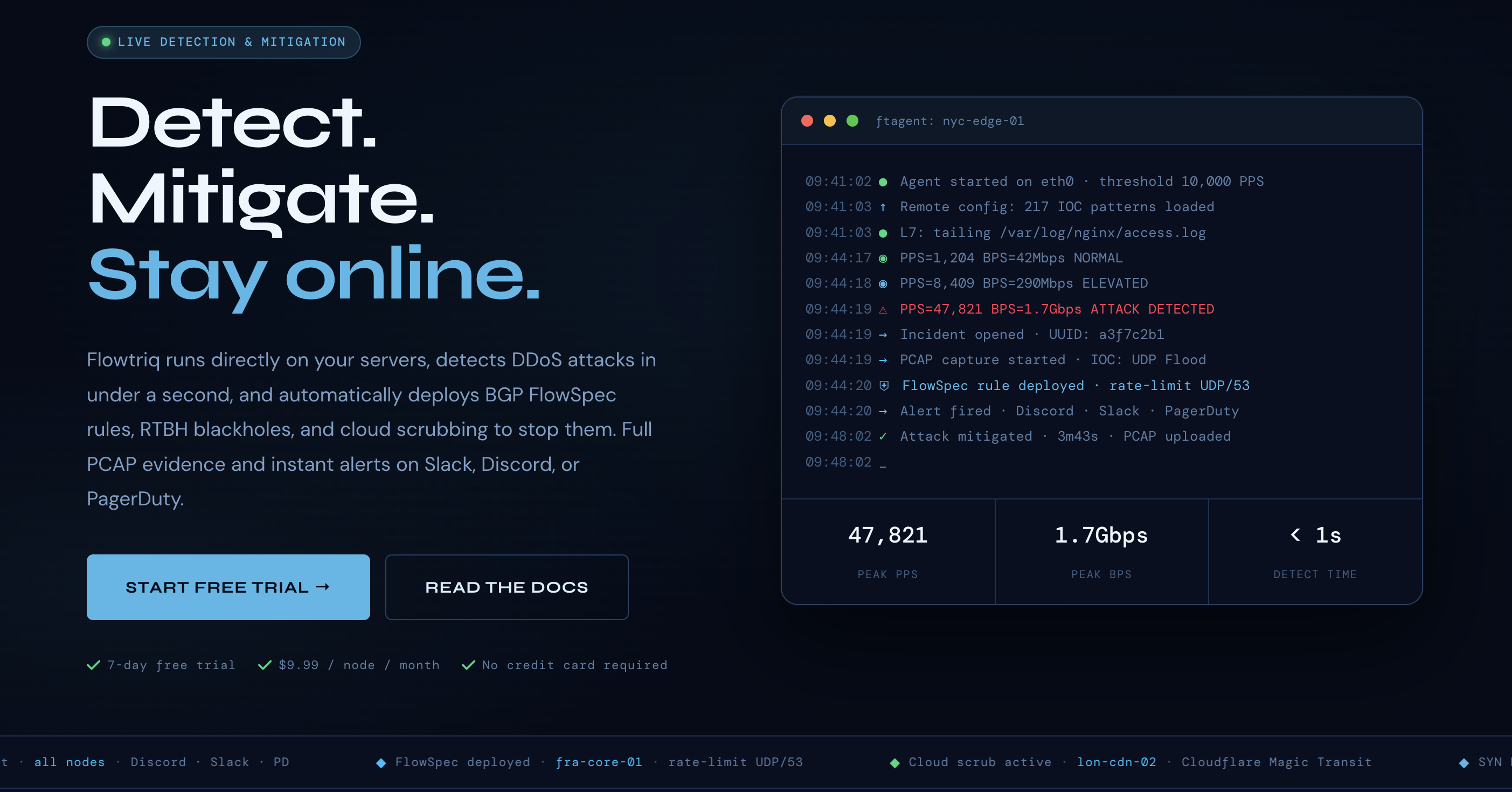
Most marketing leaders believe their biggest threat is a competitor’s ad spend; in reality, it is the three-second delay that kills conversion before a page even loads. While we obsess over customer acquisition costs (CAC) and brand sentiment, a single DDoS attack can undo years of trust-building in under sixty seconds. Flowtriq is a lightweight, agent-based detection and auto-mitigation platform designed to neutralize infrastructure threats in sub-second intervals. For the modern marketer, this isn't just an IT utility—it is a sophisticated insurance policy for your brand’s digital reputation.
The Business Case: Protecting the Conversion Funnel
In my research at The Brand File, we have consistently found that consumer patience is at an all-time low. Our data-driven analysis suggests that even a minor latency spike during a high-stakes campaign—such as a product drop or a seasonal sale—can result in a 20% permanent churn rate among first-time visitors. Flowtriq offers a compelling ROI by shifting the defensive posture from reactive to autonomous.
The platform’s sub-second detection and classification of over eight attack types (including SYN and HTTP floods) means that mitigation occurs before the end-user experiences a "Page Not Found" error. From a strategic positioning standpoint, Flowtriq allows SaaS and e-commerce brands to claim "100% Resilience" as a competitive advantage. Furthermore, because Flowtriq utilizes dynamic baseline learning, it avoids the "false positive" trap that often blocks legitimate high-intent traffic during viral marketing moments. By automating the response via BGP FlowSpec or cloud scrubbing, marketing teams can focus on growth without the looming shadow of infrastructure instability.
Key Strategic Benefits
- Operational Efficiency: Flowtriq removes the "human bottleneck" from incident response by deploying automated runbooks that fire within one second. Marketing and DevOps teams no longer need to coordinate emergency calls during an attack, as the system handles mitigation and multi-channel alerting (Slack, PagerDuty) autonomously.
- Cost Impact: At a flat rate of $9.99/node/month with no traffic surcharges, Flowtriq disrupts the traditional "tax on growth" model. By preventing downtime, brands avoid the massive revenue leakage associated with stalled checkout flows and the subsequent spike in customer support tickets.
- Scalability: The agent-based architecture allows for rapid deployment—under two minutes per node—making it an ideal solution for brands scaling across edge nodes or multi-cloud environments. Its ability to manage multiple nodes from a single dashboard ensures that as your digital footprint grows, your defensive overhead does not.
- Risk Factors: While Flowtriq is highly effective at the network and transport layers, leaders must ensure their application-layer logic is equally robust. Additionally, while the "set and forget" nature of auto-mitigation is a strength, it requires initial configuration of escalation policies to ensure alignment with specific ISP or hosting provider constraints.
Implementation Considerations: Integrating Resilience into the Roadmap
Implementing Flowtriq requires minimal technical debt, a rarity in enterprise-grade security. The installation of the Python-based ftagent on Linux servers is non-disruptive, allowing for a phased rollout that begins with mission-critical nodes. From a change management perspective, the primary shift is moving from manual threshold tuning to an algorithmic baseline.
Marketing leaders should coordinate with infrastructure teams to ensure that Flowtriq’s automated status pages are integrated into the brand’s communication strategy. This transparency during "micro-incidents" can actually enhance brand trust, demonstrating a proactive approach to security. The platform also triggers full PCAP (packet capture) for every attack, providing the empirical evidence needed for post-mortem forensic analysis and threat intelligence reporting. This data is invaluable for C-suite briefings, transforming "IT issues" into quantifiable business risk reports.
The Competitive Landscape: Efficiency vs. Complexity
When evaluating the "DDoS mitigation" sector, we categorize solutions by their "time-to-mitigation" and price-to-performance ratio. Traditional incumbents like Akamai and Cloudflare offer robust global scrubbing, but often at a premium price point that includes significant "overage" risks for high-bandwidth events.
Flowtriq differentiates itself by operating closer to the "metal"—detecting at the NIC level on your own infrastructure. While AWS Shield provides foundational protection for AWS-native assets, Flowtriq offers a vendor-agnostic layer that is essential for multi-cloud or hybrid strategies. Unlike legacy hardware appliances that require manual intervention, Flowtriq’s integration of IOC (Indicator of Compromise) pattern matching against 642,000+ threats, including Mirai variants, provides a level of intelligence usually reserved for high-end MSSPs.
Recommendation
For CMOs and COOs, the directive is clear: Digital resilience is the new baseline for brand equity. We recommend a 7-day pilot on your highest-traffic Linux nodes to establish a baseline. Start by integrating Flowtriq’s alerts into your existing Slack or OpsGenie workflows to observe the "silent" threats your infrastructure currently absorbs. If your brand cannot afford a 60-second outage, you cannot afford to manage your DDoS defense manually. Move to an autonomous posture today.