DISCO: HOW A DANCE REVOLUTION SPARKED TODAY'S MARKETING CULTURE
Architecture & Design Principles Disco’s category and feature set suggest a layered architecture: - Presentation: SPA front-end with component-level themi...
Cohorts Don’t Scale Without Automation: Inside Disco’s Human–AI Learning Core
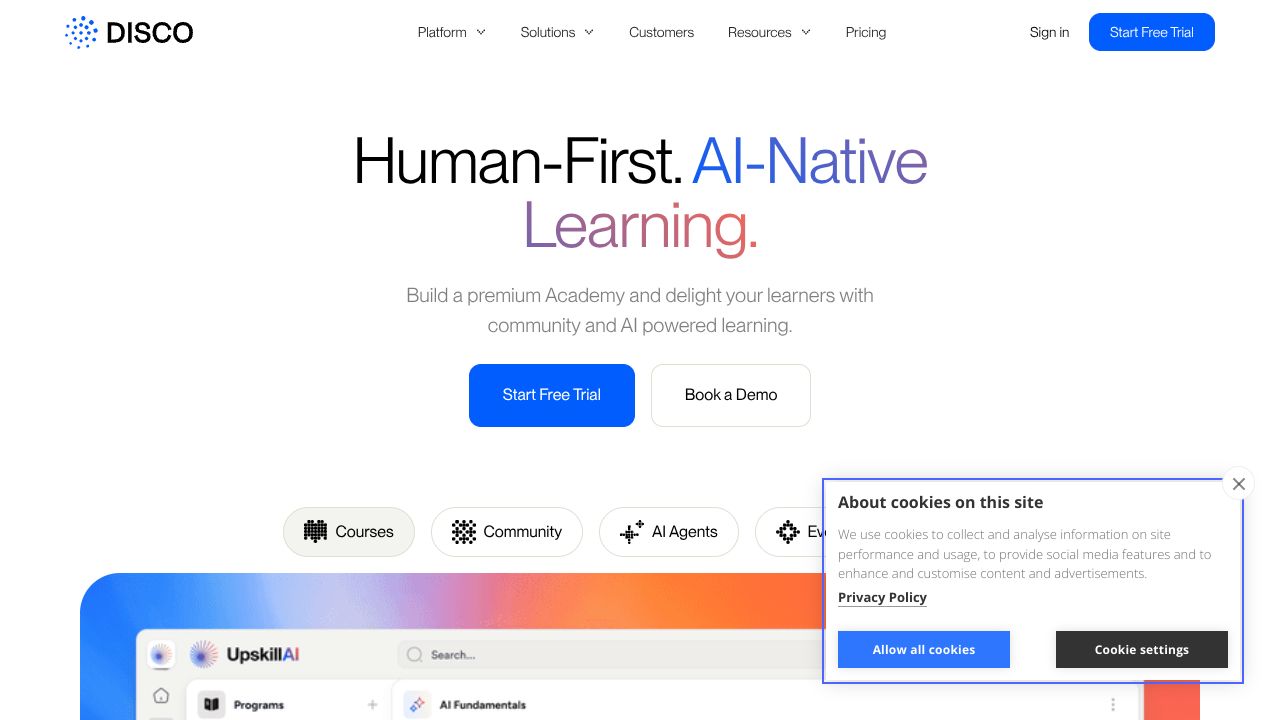
Manual course assembly can’t keep pace with modern community learning. Disco tackles this by fusing AI-led authoring with social learning mechanics and automated operations to increase retention at scale. In this Brand Files entry, our Strategy Analysis positions Disco as an AI-powered social learning platform that operationalizes branded academies and peer engagement for organizations. At its core, Disco blends an LLM-driven course builder, a real-time community layer, and a workflow engine to reduce administrative load while amplifying human connection. While the vendor doesn’t publish a full stack specification, the product surface and interaction patterns imply a modern, multi-tenant SaaS with LLM orchestration, event-driven automation, and analytics instrumentation. The design philosophy is clear: human-AI synergy over AI replacement—prioritizing creators, moderators, and learners with high-signal touchpoints. Pricing starts at $79/month (https://www.disco.co).
Architecture & Design Principles
Disco’s category and feature set suggest a layered architecture:
- Presentation: SPA front-end with component-level theming for branded academies and custom domains (multi-tenant asset pipeline and feature flags).
- Services: Separation between Content Service (courses, modules, assessments), Community Service (posts, threads, reactions, DMs), Automation Orchestrator (triggers, rules, actions), Analytics Service (engagement, completion), and Billing/Entitlements.
- AI Authoring Pipeline: LLM orchestration for syllabus generation, metadata tagging, and content transformation; retrieval over existing assets via embeddings; human-in-the-loop review states.
- Data: Tenant-scoped data domains; relational store for core entities; object storage/CDN for media; vector index for semantic search and content recommendation.
- Scalability: Event-driven queues for background tasks (transcription, summarization, notification fan-out); horizontal scaling of stateless services; caching for read-heavy community endpoints.
- Observability and Governance: Audit logs, analytics dashboards, and policy-based access control to support enterprise readiness.
This modularity lets Disco isolate throughput-heavy community features from latency-sensitive AI authoring and long-running automations.
Feature Breakdown
Core Capabilities
-
Feature 1: AI Course Builder
- Technical explanation: Ingests source materials (documents, transcripts) and uses LLM prompt-chains to generate learning objectives, outlines, lesson content, and assessments. Likely employs embeddings for retrieval-augmented generation and metadata extraction (difficulty, prerequisites, tags). Supports review states for instructors before publish to maintain pedagogical quality.
- Use case: A marketing team converts a 60-minute product webinar into a 5-lesson onboarding micro-course. The system auto-generates summaries, knowledge checks, and a suggested drip cadence; instructors edit tone and add brand assets, then publish to a specific cohort.
-
Feature 2: Social Learning Engine
- Technical explanation: Real-time community channels, threads, and reactions over WebSockets/SSE; notification services for mentions and milestones; role-based permissions (instructors, moderators, learners). Recommendation logic can use engagement graphs and content embeddings to surface peer discussions adjacent to lessons.
- Use case: During a “positioning sprint,” learners post artifact drafts, receive structured peer feedback, and moderators spotlight top submissions. The platform nudges quiet members with timely prompts tied to course milestones to lift participation and retention.
-
Feature 3: Automated Operations
- Technical explanation: A rule engine connects triggers (enrollment, module completion, inactivity thresholds, event RSVPs) with actions (messaging, email sequences, cohort assignments, calendar invites, CRM/webhook calls). Idempotent job execution and retries protect against double-sends; schedules and rate limiting handle large cohorts without notification storms.
- Use case: On enrollment, learners receive a personalized welcome, are auto-added to the right channels, get a calendar block for the first live session, and—if inactive for 5 days—receive a context-aware recap and CTA, improving week-one activation.
Integration Ecosystem
Disco’s value compounds through connections: REST APIs for content and user management; inbound/outbound webhooks for lifecycle events (user.created, lesson.completed, post.created); SSO via OAuth/SAML for enterprise identity; and connectors to comms (email providers, Slack),